P-01
FRC equilibrium
Tuszewski and Steinhauer set out the equilibrium and confinement physics of high-beta field-reversed configurations.
Tuszewski, Nuclear Fusion 28 (1988) · Steinhauer, Physics of Plasmas 18 (2011)
Public technical case
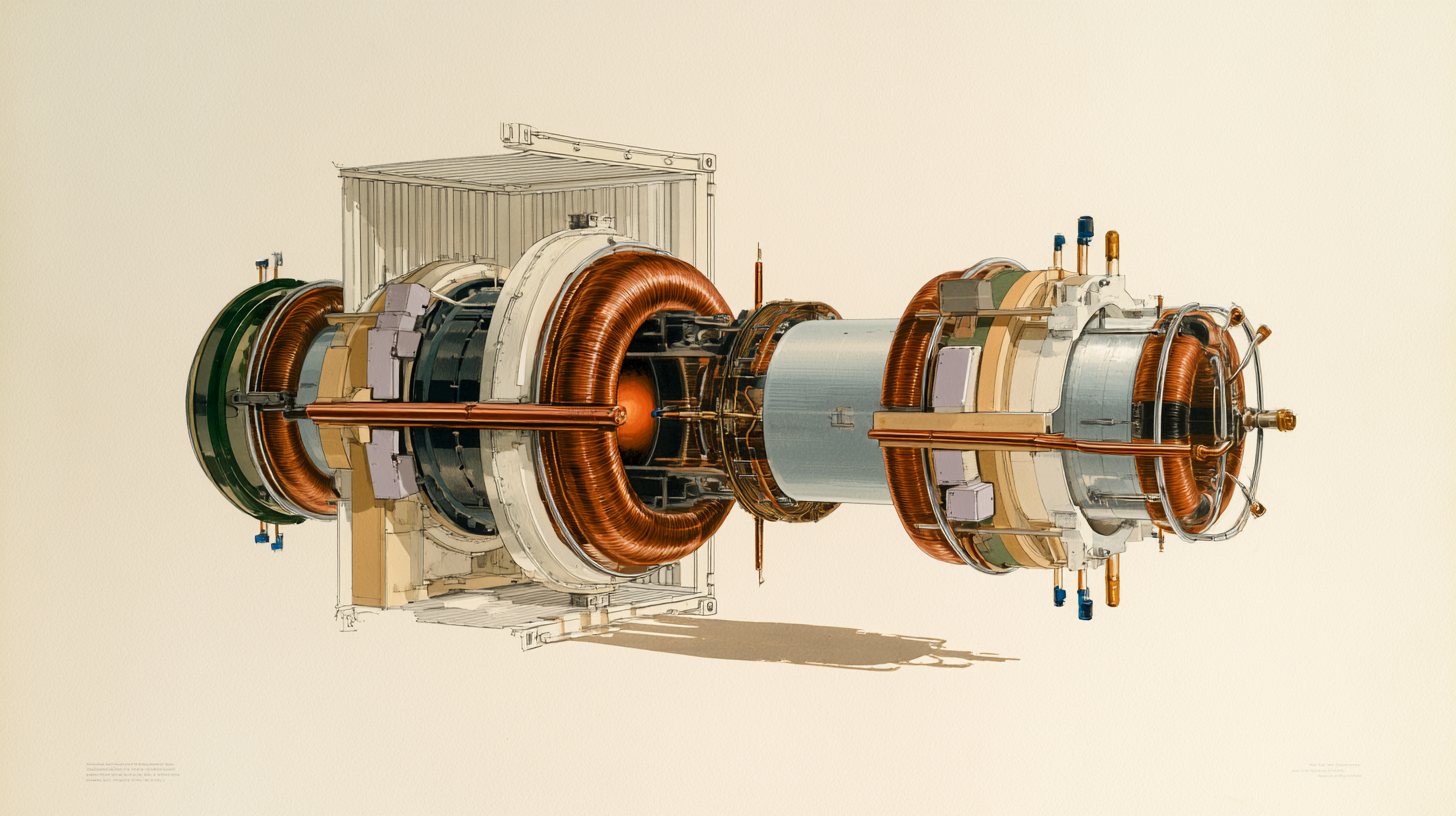
Published experiments have formed, merged, and compressed FRC plasmas. Laurelin's proposed machine adds direct recovery and a protected electrical measurement to that sequence.
FIG. 01 · CONCEPT STUDY
§I · Public record
They cover FRC equilibrium and formation, merging with magnetic compression, and direct conversion. No cited experiment joins them in the complete Laurelin cycle.
P-01
Tuszewski and Steinhauer set out the equilibrium and confinement physics of high-beta field-reversed configurations.
Tuszewski, Nuclear Fusion 28 (1988) · Steinhauer, Physics of Plasmas 18 (2011)
P-02
Published experiments have formed hot, stable field-reversed configurations.
Gota et al., Nuclear Fusion 59 (2019)
P-03
Published experiments have merged two colliding FRCs and produced high-temperature plasma through merging and compression.
Slough, Votroubek & Pihl, Nuclear Fusion 51 (2011)
P-04
Published theory and experiments establish direct conversion in principle. No cited paper reports its integration with a compact pulsed FRC at engineering relevance.
Barr & Moir (1976) · Takeno et al. (2000, 2019, 2023)
§II · The open test
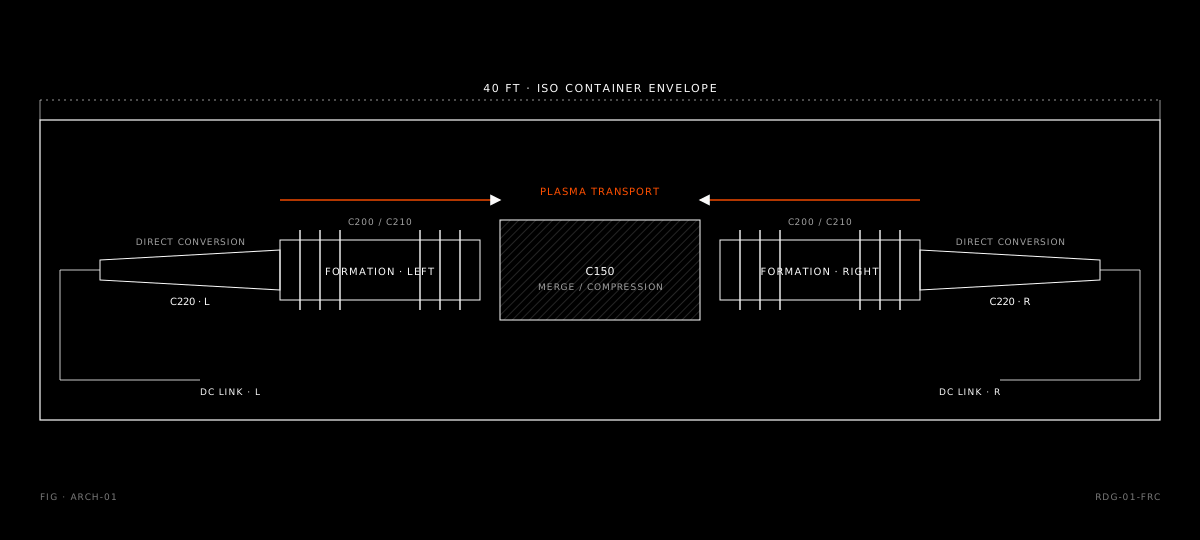
Laurelin's design puts the published mechanisms in one test. A passing record shows useful peak conditions within hardware limits and metered electrical work at the protected boundary, reproduced at engineering-relevant cadence.
Published record
Open operating record
One repeatable pulse with metered electrical work§III · Proposed pulse sequence
Direct recovery from the pulsed FRC and repetition of the complete sequence remain open integration work.
Form the two FRC plasmas used in the shot.
Merge the two plasmas into one FRC.
Raise the merged plasma's density and temperature with magnetic compression.
Return electrical work through the proposed direct-conversion channel and meter it at the protected boundary.
Reset the machine and reproduce the full record at an engineering-relevant cadence.
§IV · Compactness
High beta is the physical basis for compactness. At fixed magnetic field and plasma content, the FRC equilibrium permits a smaller device volume. Pulsed operation puts energy input and returned work on the same shot record, including the cadence between shots.
HIGH-BETA EQUILIBRIUM
An FRC is a compact toroid with no central rod. Its high-beta equilibrium permits high plasma pressure relative to the magnetic pressure used to confine it.
BOUNDED PACKAGE
Recovery, shielding, instrumentation, and service interfaces must close as one bounded object. Moving those burdens into the host site would be deferred bulk, not compactness.
§V · Fuel constraint
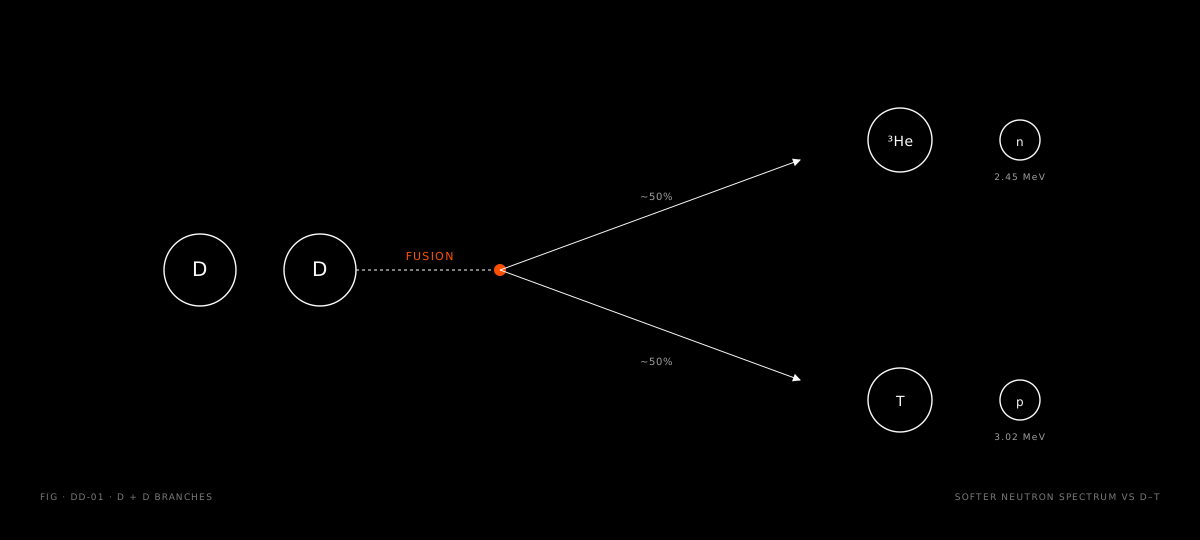
The public brief puts the minimum Lawson-product requirement for D-D at roughly two orders of magnitude above D-T. The proposed machine must absorb that penalty in its per-pulse energy ledger.
Deuterium is the terminal fuel, so operation does not depend on an externally supplied strategic isotope inventory. The reaction branches still produce tritium, helium-3, and neutrons.
§VI · Direct recovery
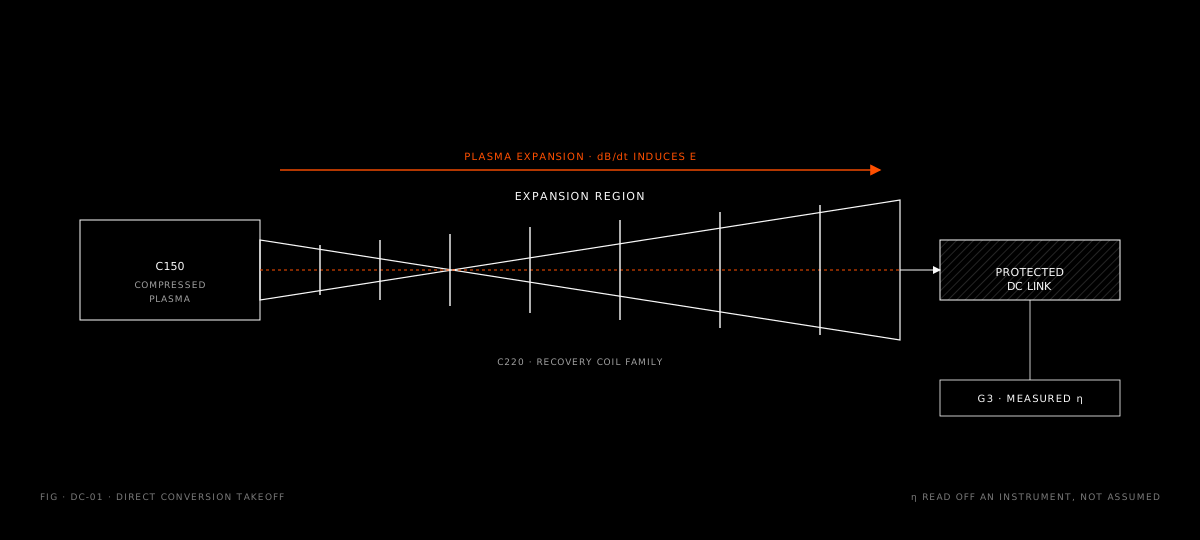
The pulse delivers energy on microsecond-to-millisecond timescales. Direct electromagnetic conversion addresses it in the same time domain. Thermal capture remains necessary for energy outside the direct channel.
Protected-boundary ledger
§VII · Failure conditions
A strong plasma result cannot compensate for failure in repeatability, material survival, protected recovery, or package integration. Each condition needs its own record.
E-01
Can the high-β FRC equilibrium be reproduced at the repetition rate deployment economics require? The public record is still dominated by short-pulse, low-duty-cycle campaigns.
E-02
The ²H–²H neutron spectrum sets the plasma-facing-material, activation, and service budgets. Closure requires a qualification record measured on the operating spectrum itself.
E-03
After the burn, plasma expansion drives current through the recovery coils to the protected DC link. Every pulse meters the electrical work it returns.
E-04
The core envelope, adjacent balance of plant, service boundary, and regulatory surface must compose at operational scale. Packaging only matters if the deployment system closes around it.
Public sources
It contains the full energy ledger and source list behind this page.