3–4%
annual electricity-demand growth after a decade of slow growth

§ I · THE MISSION
The case begins with load, transmission, and siting.
Read the argumentTHE CASE
Nearly 2,300 GW of proposed generation sat in US interconnection queues at the end of 2024, and a project energized in 2025 took about 2,100 days from request to operation (LBNL, Enverus). Data centers and industrial sites now add load faster than the grid can connect it.
Laurelin is building a Gen 3 fusion machine. Gen 1 was the science experiments. Gen 2 is the billion-dollar reactor programs, and their work paid down the superconductors, the supply chain, and the stability results a latecomer inherits. Gen 3 builds the product: a pulsed machine that ships in a forty-foot container, 10 MWe per unit at a $5.0M target price, fueled by deuterium from heavy water, with drive energy returned electromagnetically. It arrives by truck, connects at the load, and the customer owns it outright. The queue stops mattering.
Read the public whitepaperPUBLIC WHITEPAPER · §1
Demand is accelerating after a decade of slow growth. The interconnection system is carrying far more proposed generation than its historical completion record converts into operating capacity.
3–4%
annual electricity-demand growth after a decade of slow growth
≈1,300 TWh
IEA central projection for data-center electricity demand by 2035
2,289 GW
in the U.S. interconnection queue at the end of 2024
Figures and source chain: Laurelin public whitepaper. The 2,289 GW queue figure is paired there with a historical completion rate of approximately 14%.

THE CONSTRAINT
Power that waits for a transmission interconnect arrives half a decade late. The buyer’s answer is generation behind the meter, on their own site, on their own schedule. That is the market this machine is built for, and the whitepaper prices it.
01
A campus that draws hundreds of megawatts around the clock needs firm power behind its own meter, on its own schedule.
02
A production line prices power by the hour it is actually there. Firm and dispatchable is the specification.
03
A remote site pays for its power twice: once at the meter and once in the convoy that keeps the fuel coming.

PUBLIC WHITEPAPER · §5.4
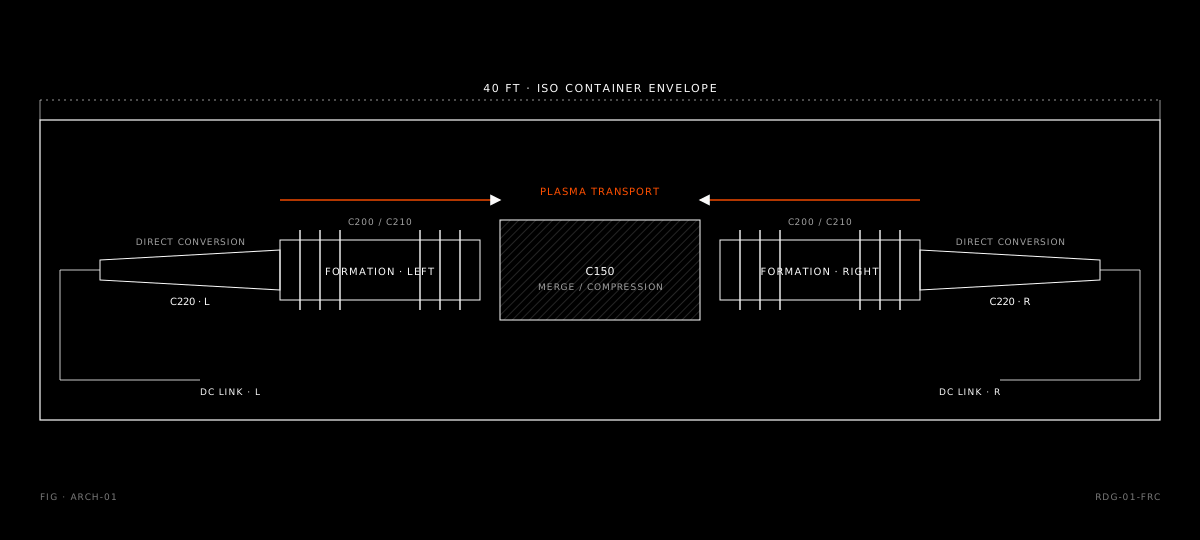
The packaging commitment is precise: reactor-core hardware inside a forty-foot shipping-container envelope, balance of plant as adjacent modules. Every piece moves on a truck, a railcar, or a ship that already exists.
THE ARCHITECTURE
Each commitment changes the shape of the machine, its evidence ledger, and its deployment surface. The four together are the architectural claim, and each one carries its own bench test.
01
Terminal fuel
A harder confinement problem paired with a supply chain outside another sovereign’s strategic inventory.
02
Confinement
A compact, high-β configuration evaluated as a repeatable per-pulse machine.
03
Recovery
Electromagnetic recovery as the primary channel, with thermal capture as a necessary complement.
04
Envelope
Reactor-core hardware inside a forty-foot envelope; balance of plant in adjacent modules.
§ V · THE EVIDENCE STANDARD
Every claim above maps to a bench measurement with a threshold and a date. Recovery is measured without plasma at month ten, before the integration spend. The architecture stands or falls on a public operating record, and we publish the record either way.
E01
Demonstrate high-duty-cycle FRC stability at the repetition rate the deployment economics require.
E02
Build a materials-qualification record against the operating neutron spectrum and service envelope.
E03
Meter the electrical work each pulse returns to the DC link, with uncertainty recorded.
THE NEXT SITE
Laurelin is in conversation with prospective host sites now. Bring us the capacity, the target date, and what is known about the site, and we will tell you what the machine has to prove first.