The tritium plant inside D–T
The standard fusion textbook opens with deuterium–tritium because the reaction cross-section peaks at lower temperature than any other accessible fuel. The textbook is not wrong; it is incomplete. Tritium is not a fuel that exists. It is a fuel that has to be bred, on-site, from lithium, inside a blanket designed for the purpose, with a tritium breeding ratio greater than one and a closed inventory accounting that satisfies a regulator. Every D–T machine inherits a tritium plant.
Paying the cross-section penalty
We do not want to inherit a tritium plant. So we pay the cross-section penalty and burn deuterium–deuterium. Deuterium is in seawater, costs roughly nothing, and is not regulated as a special nuclear material. The penalty is real — D–D requires higher plasma temperature and longer confinement than D–T to reach equivalent fusion power — and our architecture is built to pay it.
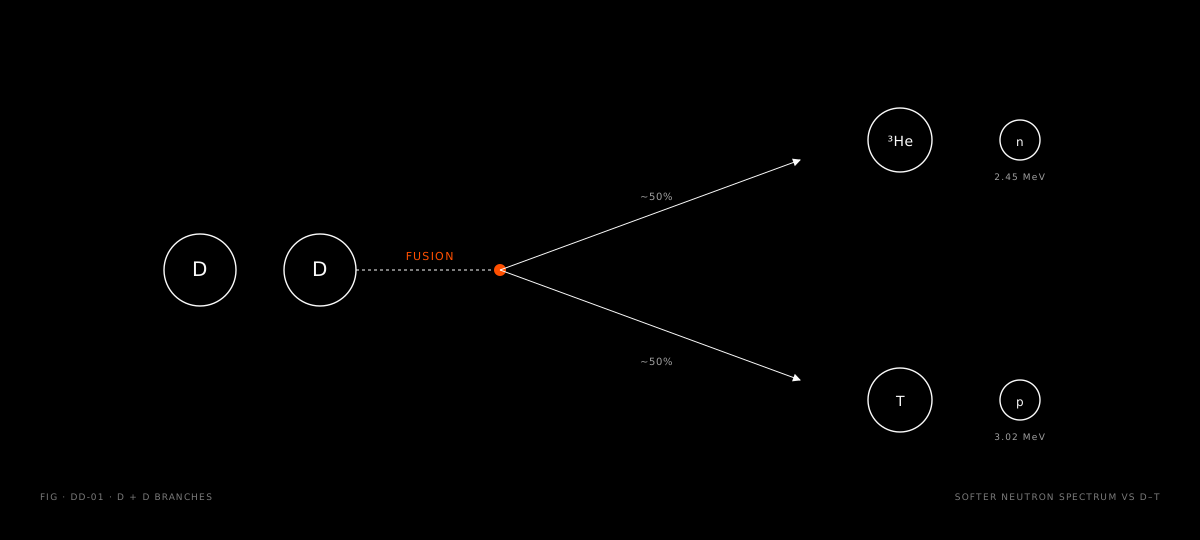
The D–D reaction has two roughly equal branches. One produces helium-3 and a neutron at 2.45 MeV. The other produces tritium and a proton. The tritium then either leaves the plasma or burns in-situ via D–T side reactions. The neutron spectrum from a D–D machine is softer and lower-flux than from D–T at equivalent fusion power, which makes the shielding integral and activation budget for the container envelope materially easier.
Closing the engineering integral
The case for D–D is not that it is easier. It is that the engineering integral closes inside a forty-foot envelope without a tritium plant bolted to the side.