A roadmap is not a falsifiable program
Most fusion programs publish a roadmap. Roadmaps are forward-looking arrows on a slide. They communicate intent. They do not communicate falsifiability. A roadmap can slip indefinitely and never resolve.
Declare the no-go signal first
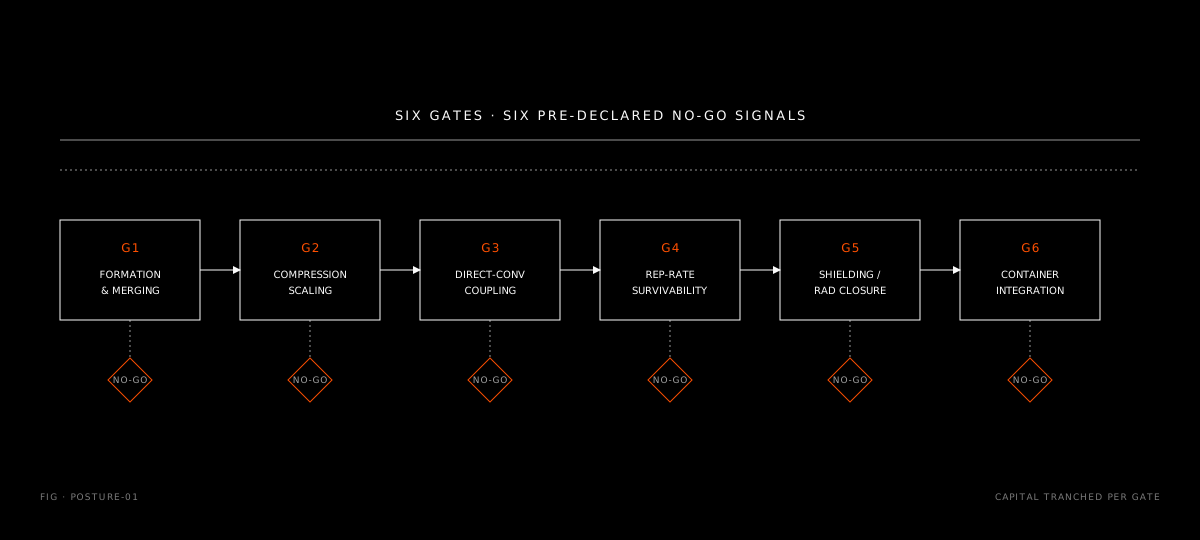
A stage gate is the opposite of a roadmap arrow. A gate is a measurement, declared in advance, with a numerical pass/no-pass band that the program either clears or does not. A no-go signal at a gate is the explicit shape of the failure that ends the program. We write the no-go signal before we run the experiment.
Six gates, each tied to a measurement
We have six gates: formation and merging, compression scaling, direct-conversion coupling, repetition-rate survivability, shielding and radiation closure, and container-class integration. Each carries a measurement criterion, an instrument that produces it, and a pre-declared termination condition. Capital is committed in tranches sized to the next gate, not to the program as a whole.
Investor protection is the point
The point of this structure is not optimism management. It is investor protection. A stage-gated program returns capital instead of consuming it indefinitely. The cost of a no-go is a known number written down at the start, not an open-ended draw.